Sally K. Norton

Vitality Coach, Speaker & Health Consultant

  • Home
  • About
    • Interviews, Talks, Media and More
  • Symptoms
  • Relief
    • Nourishment
    • Results
  • Science
    • Oxalate Basics
  • Books
    • Data Companion
    • The Essential Low-Oxalate Cookbook
  • Support
    • Upcoming Events
    • Support Groups
    • Shop / Downloads
    • Sign-up for News and Updates
    • Speaking and Presentations
  • Recipes
    • Fundamentals
    • Sauces and Condiments
    • Beverages
    • Finger Foods
    • Soups
    • Salads
    • Side Dishes
    • Meats and Seafood
    • Treats
  • Blog
    • Table of Contents
  • Contact

April 9, 2017 by Sally K Norton

Sloppiness of Standard Practices in Science

Copyright: teamarbeit / 123RF Stock Photo

The public is unaware of many problems in how science is conducted and the ramifications for patient health.

For example, poor handling and significant time lapse before pathologists see the fragile and perishable tissues they examine can yield unreliable, meaningless data. Richard Harris discusses such problems in modern biomedical science in a new book, Rigor Mortis: How Sloppy Science Creates Worthless Cures, Crushes Hope, and Wastes Billions. The book is long overdue! It is certainly an important topic in need of some light, and I’m looking forward to reading it. Thanks to Richard Harris for tackling this massive problem!

In a book excerpt on the NPR site, Harris describes how researchers finally revealed one of the hidden problems in pathology.  While evaluating a breast cancer test, researchers in a lab at the University of Rochester let breast tissue biopsy samples sit out for an hour or two before testing them. They didn’t realize that at room temperature, the sample decays! Folks: dead tissues decay, and decay changes what a pathologist can detect.  Harris writes:Rigor Mortis Book Cover

“And that was enough to degrade the sample and turn a positive result into a negative one. The molecule detected by the HER2 test breaks down at room temperature. “You can have the best test in the world and still get the wrong answer if you bugger up what you are testing,” Compton said.”

Oxalate Detection is a Problem for These Same Reasons Too

This problem of tissue degeneration is certainly true for oxalate crystals. These crystals are known to disappear from tissue samples within 2 hours of death, especially from the thyroid gland. Surgeons and their assistants lack training in the best methods for preserving biopsy samples and do not prioritize a speedy passage to the microscope. These processes are not priorities for biomedical institutions. Science and the public both suffer as a result.

I will write more soon about problems in tissue sampling and examination, focusing on overlooked oxalate deposits.  Unseen due to normal but faulty biomedical procedures, oxalate deposits in human tissues are more common than believed by researchers.

Link to NPR book excerpt:

http://www.npr.org/books/titles/522223284/rigor-mortis-how-sloppy-science-creates-worthless-cures-crushes-hope-and-wastes#excerpt

March 29, 2017 by Sally K Norton

Swiss Chard: Popular But Potentially Hazardous

Three Grocery Produce shelves filled with bundles of fresh swiss chard standing upright

I used to eat this stuff as a normal and healthy thing to do. Swiss chard and I go way back, ever since my mother told me to plant it in my first garden when I was 10 years old. It germinates easily and it isn’t bothered much by pests. The large leaves are easy to harvest and the plant looks great in the garden. And, most important to my mother, it is a cut-and-come-again plant that yields a continual and bountiful crop. It was good that it was so easy to grow, because grocery stores rarely carried it. All that has changed.

Mountains of Swiss Chard at the Store

Swiss chard has grown popular—very popular, if the amount of refrigerated space allotted to it in our local organic supermarket is an indicator. I was there last week on a hopeless quest for mustard greens. I asked the young man restocking the produce case if they had mustard greens, but like the other stores in town, he said they don’t carry them anymore.

Then I noticed that he was unloading swiss chard—at least 40 colorful bunches, fresh out of their shipping boxes into a 4’ 4’ section devoted solely to swiss chard. The greens looked marvelous, but I could only sigh and worry. In my astonishment at the amount of store space devoted just to swiss chard, I commented on it as he piled it up. He said that they sell a “crazy amount of it”, but he’s never tried it.

Hidden Danger: Oxalate

Swiss chard is a hot trend! It has joined the ranks of kale and spinach as top sellers in the fresh greens department. Too bad. Swiss chard is loaded with a natural toxin called oxalate. Just one half-cup of steamed white-stalked swiss chard has about 500 mg of oxalate and ½ cup of steamed red swiss chard has over 900 mg of oxalate. [1] Steamed spinach has about 700 mg per ½ cup. That is a lot of oxalate.

Doctors and researchers assume you only consume about 120 mg of oxalate per day! 120 mg is about the amount of oxalate in just one ounce of almonds. But, a ½ cup of swiss chard has 4 to 7 times that amount – far in excess of what is considered “typical” and “tolerable” on a routine basis. That half cup of spinach has about 6 times the daily expectation. Oxalates have enormous health consequences: If you happen to like nuts and swiss chard, spinach, or beet greens you could be heading for physical pain, poor sleep, or kidney stones.

Ignoring a Brain Toxin

Until 2009, I paid no attention oxalates in my foods. I did not know or care that I routinely ate foods loaded with oxalate. I never connected my weird symptoms of nightly hiccups, belching, restless legs, and poor sleep to my diet. Why would I suspect my diet? I was eating fresh, whole, healthy foods—all the time, every day. I served swiss chard about twice a week and sweet potatoes at least five days a week, believing they were good for me. My diet could not be blamed for my health problems.

So later, I was shocked when I accidentally cured my sleep problem by eliminating high oxalate foods like swiss chard (including my beloved sweet potatoes). I learned that oxalates are neurotoxic. That is, they bother the nerves and brain. I also learned from reading medical articles that hiccups are a sign of this neurotoxicity (which covers a spectrum of symptoms including hiccups, convulsions, and death).  (Here are a few of those articles: Neto 1998; Chen, Chou et al 2002; Chang, Hwang, et al 2000). There must be a reason the bugs don’t mess with the swiss chard in the garden—it may be too toxic for them, too!

The Danger of Innocence

My ignorance about the oxalate content of foods and about the toxic potential of oxalate in foods left me at risk for self-inflicted poisoning. That turned out badly for me, and for my husband. As a last resort, I corrected this dietary mistake and was surprised at the results as we each recovered effortlessly from chronic health conditions.

Anyone can get into trouble from overdoing the high oxalate foods. This is especially relevant now when high-oxalate foods are growing in popularity and are available year round.  The produce aisle has become a loaded gun, and we are the innocent kids who have no idea about the dangers lurking there.

Healthy, Safer Greens

If you want to avoid accidental harm from oxalate, drop the swiss chard, beet greens, and spinach. And tell the produce manager you would buy mustard greens (6 mg oxalate per ½ cup steamed) and other low-oxalate produce, if only they would stock them.

Indeed, there are other good options for cooked greens. For example:

  • Lacinato (aka Dino) kale (4 mg ox per ½ cup cooked),
  • green cabbage, cooked (4 mg ox per ½ cup),
  • arugula, cooked (7 mg ox per ½ cup),
  • turnip greens (10 mg ox per ½ cup steamed), or
  • dandelion greens (10 mg ox per ½ cup steamed).

Many raw salad greens are also safe:

  • romaine lettuce (0.5 – 2 mg per ½ C),
  • mache (corn salad) (0.4 mg per ½ C),
  • watercress (2 mg per ½ C), and
  • arugula (0.7 per ½ C).

Rest Well

What mustard greens and romaine lettuce lack in hipness and glamor, they make up for by letting you sleep at night!


  1. The values of oxalate content presented here are based on testing performed at the University of Wyoming in Laramie on behalf of the VP Foundation.  http://thevpfoundation.org/vpfcookbook.htm

February 23, 2017 by Sally K Norton

Arterial Plaque Contains Oxalate

Did you know that oxalates can damage your heart and circulatory system, contributing to heart disease?

Our kidneys clean the blood. All of the oxalate that kidneys excrete every day gets there by traveling in our blood stream. The job of delivering toxic oxalate to the kidneys puts the arteries in harm’s way.

Researchers Don’t Expect Oxalate in Tissues

When oxalate deposits are found in tissues (other than the kidneys) doctors and researchers are surprised that the kidneys are working just fine. They believe that before oxalate collects in our bodies, the oxalate must first ruin the kidneys. This passage, below, from UCLA Pathologists Fishbein and Fishbein illustrates this conventional belief.

In a review of coronary arteries from 80 patients, we found 4 cases in which there were prominent oxalate deposits within the atherosclerotic plaques in coronary arteries. Oxalate deposits were also present in the media of arteries, the thyroid gland, and other organs, but not the kidneys, and the patients surprisingly did not have renal failure. (Fishbein and Fishbein 2009, p. 1315)

This expectation is based on the long-standing but unproven assertion that detectable (non-renal) oxalate deposits are a product of poor kidney function. In a previous report published by the journal Cardiovascular Pathology in 2008 they propose the new term “atherosclerotic oxalosis” to describe arterial plaque containing oxalate crystals.

This report was part of a study of coronary atherosclerosis in HIV infected patients, using atherosclerotic plaque samples from the National Neurologic AIDS Bank.

Whenever oxalate flows into the kidneys and other tissues in amounts beyond what they can handle (exceeding a capacity threshold), oxalate overload can occur. This can trigger accumulation of oxalate in the body. For some people this shows up as kidney deposits and kidney stones.  But oxalate can encounter, be stashed, and be left behind in any susceptible tissue in the body, not just the kidneys.

Other Forms of Oxalate are Usually Overlooked

Note the use of the term prominent in the comment quoted above. The researchers do not mention trace deposits, nano-crystals, ionic oxalate, and other chemical forms of oxalate in the examined tissues as a possibility. Unexplored, no doubt.

There is also no mention of the age of the specimens at the time of examination. We know that oxalate deposits rapidly fade in biopsied tissue and cadavers. (It would be interesting to see a study specific to arteries and arterial plaque to investigate the durability of less prominent oxalate deposits in plaque.) To reliably find oxalate, living tissues need to be examined within two hours of death or excision, but often are not. This may help to explain why oxalate in the arterial plaque is assumed to be rare, it can be hard to detect.

Calcium oxalate may be a factor in “hardening arteries”. And it may be more common than this research suggests, given the crude detection methods we use. Artery plaque oxalosis is most likely in people with metabolic stress such as HIV, metabolic syndrome, chronic inflammation, diabetes, insulin resistance, chemical injury, poly-pharmacy, auto-immune conditions, and so on. We don’t know how oxalate may harm “healthy” people with “perfect” arteries.

Over and over, science has demonstrated that oxalate can collect in any tissue in the body—and not necessarily due to kidney problems.

Reason enough to become oxalate aware!


Here is an update: an 2017 report of an Italian study looking at heart artery plaque in 229 people, obtained through a tissue bank. They did a special microanalysis in 41 plaque samples to differentiate between two types of calcifications: calcium oxalate vs hydroxapatite. 37% of the plaques were primarily calcium oxalate and 63% were hydroxyapatite. Oxalate calcifications were detected mainly in unstable plaques in 27% of cases, whereas HA tended to dominate unstable plaques 60% of the time.
Of course, unstable plaques are the ones that tend to break loose and block fine capillaries, restricting blood flow to brain or heart tissues thus causing non-hemorrhagic stroke or heart attacks . https://www.ncbi.nlm.nih.gov/pubmed/28739184

January 14, 2017 by Sally K Norton

Celebrating Life!

“I Like Feeling Good!”

In this short video, Cathy explains how the low-oxalate diet has improved her life: eliminating back pain, mouth tartar and cavities, brain fog, energy issues, and chemical sensitivity.  Her enthusiasm for what she learned in my previous talks and support group is contagious.  Cathy wants you to feel good too!

Celebrate Low-Oxalate Living: “Happy Birthday, Cathy!”

For her birthday celebration, Cathy organized a low-oxalate talk that I presented at Ellwood Thompson’s Local Grocery in Richmond, Virginia, on January 18, 2017.

November 6, 2016 by Sally K Norton

Thai Chili / Sloppy Joe

Chili without the oxalates!! This easy and flexible “hamburger extender” can be eaten as a main dish, used in wraps, or as a chili garnish for hot dogs. Use lamb or pork, if desired. This approach also works with left-over meats – like a “hash”.

Thai Chili / Sloppy Joe

  • Servings: 4-6
  • Oxalates: Low
  • Time: Prep: 20 minutes; Total: 1 hour
  • Difficulty: Easy
  • Print

Ingredients
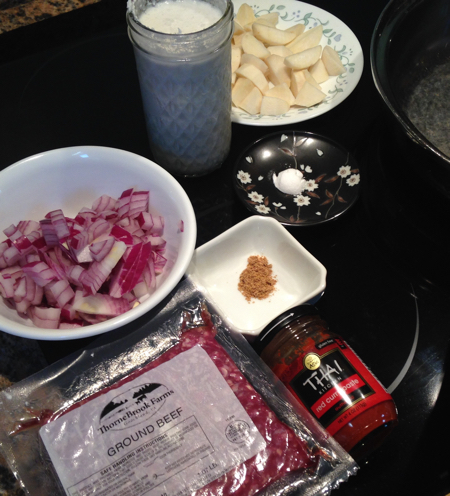
Thai Chili ingredients ready for cooking.

Thai Chili ingredients ready for cooking.

2 T beef tallow, lard, or coconut oil

6 ounces turnips, peeled and diced (est. 8 mg oxalate)

1 onion (6 – 8 ounces, red or yellow), peeled and diced (est. 10 mg oxalate)

¼ tsp. coriander (5 mg oxalate)

½ tsp salt

1 pound ground beef or other meat

2 T Thai red curry paste

12 ounces (1 can) coconut milk

2 tsp. potato starch

2 T Frank’s hot sauce

Cilantro leaves for garnish

Lime wedges for serving

Instructions

Dish of Chili served with acron squash and garnished with chopped cliantro and lime wedge

Chili served with acorn squash

  1. Sauté turnips and onions in the fat for 15 minutes on medium-low.
  2. Turn heat up to medium. Add ground coriander, salt and ground beef. Cook just long enough to brown the meat.
  3. Add the curry paste and stir to incorporate.
  4. Combine the coconut milk and potato starch, then add to meat mixture.
  5. Simmer on low heat until the sauce thickens, about 10 minutes.
  6. Add hot sauce.
  7. Serve as a sloppy joe mix, or use as you would any chili. Garnish with cilantro leaves or lime wedges. Squeeze lime over portion before eating.

July 2, 2016 by Sally K Norton

Vitamin D Lamp: This little light of mine, finding time to let it shine.

Healthy Sun Solution with a Sun Lamp

Here in this video you can see my “electronic sun”. This easy-to-use vitamin D lamp has specialized UVB emitting bulbs intended to emulate natural sun. For most of us, brief sessions with such a lamp may improve our vitamin D status and general health. Making time in your busy life can be a challenge, however. Check out my own solution in the video to see how I fit this practice into my own schedule.

Read on to learn more about vitamin D and the advantages of the lamp.

Vitamin D

Deficiency of vitamin D is not only terrible for bone health, it increases your risk of almost any disease and lowers your life expectancy. Low D levels are epidemic these days. It is common in every age group, and especially common among dark-skinned people. This is because the natural way to “get” vitamin D is to make it with your own skin, when the sun shines.  The sun’s ultraviolet B (UVB) rays interact with cholesterol (7-DHC) in the skin to make precursors that your body can convert to vitamin D.  Skin pigment blocks UV penetration, protecting skin from UV damage, but limiting vitamin D production. Other factors that limit D production in skin include aging and sunscreen use.  The strength of the sun is also a factor, varying by time of day and season, and lower at higher latitudes.

Sunlight – We Need It.

Correcting vitamin D deficiency is an important aspect of health and healing. Vitamin D deficiency is associated with insulin disorders, autoimmune disorders, cancer, and even risk of infectious disease. Many experts recommend routine oral supplementation.  But there is some evidence of short-comings and side effects to this approach that we still do not understand well.

For those with inefficient vitamin D absorption, oral supplements do not correct the deficiency. For others who do absorb oral vitamin D, there are still drawbacks. Some suspect that daily consumption of D3 may encourage excessive absorption of calcium from the intestinal tract or movement of calcium out of the bones, which can create other problems.  To minimize these issues, it seems better to take D periodically in large doses, not in daily small doses.  But not everyone can tolerate pills and supplements at all:  such people especially need to generate vitamin D naturally from UVB rays (sunshine or sunlamp).

Practical Sun Exposure with a Lamp

Given the limitations of oral supplements, making the most of your skin’s ability to produce vitamin D is a good idea. But modern life makes it impractical to get regular sun exposure, even in the summer months. And UV radiation is insufficient in the northern U.S. during the winter months, November through February.  Many other variables influence how much UV light your body needs to make adequate vitamin D.

For pale skinned folks five minutes a few days a week might be enough. The darker your skin the longer the exposure needed. You can’t necessarily force your skin to make a lot of vitamin D from UVB, however. There are biological limits. So keep in mind that more time in the sun or under the lamp may not be better for you. Remember to have you doctor measure your vitamin D levels with blood testing.

April 9, 2016 by Sally K Norton

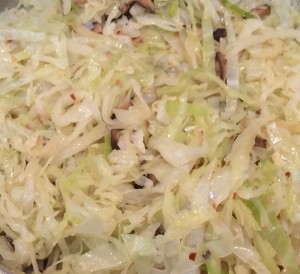
Cabbage with Shiitake Mushrooms and Dried Shrimp

When you need an Asian flavor, this Taiwanese dish uses simple pantry ingredients that are easily kept on hand. We adore this recipe!

Cabbage with Shiitake Mushrooms and Dried Shrimp

  • Servings: 4-6
  • Oxalates: Low
  • Time: Prep: 15 minutes; Total: 1 hour
  • Difficulty: Easy
  • Print

Ingredients

4 dried shiitake mushrooms, soaked in 1½ cups cool water until reconstituted (30 minutes)
1 T dried baby shrimp, soaked in ½ c warm water for 10 minutes
3 T lard, duck fat, or peanut oil
2 cloves garlic, minced
1 lb. green cabbage, shredded
½  tsp. red pepper flakes
¼  tsp. real salt, or more to taste

Instructions

  1. Drain the shrimp, discarding the liquid. Squeeze excess water out of shrimp, then chop them.
  2. Pour the mushroom soaking water through a very fine sieve and reserve.
  3. Slice the mushrooms into fine slivers, discarding tough parts from the stems.
  4. Heat the fat in a large skillet. Add shrimp, mushrooms and garlic. Stir until hot and fragrant.
  5. Add the cabbage, salt and red pepper flakes. Toss the cabbage over the heat for 2 minutes.
  6. Add half of the reserved mushroom water, bring to a strong simmer. Reduce heat to low, cover and cook for 10 minutes.
  7. Remove lid, simmer and stir to allow the cooking liquid to reduce by half.
  8. Adjust seasoning.
  9. Serve immediately. Offer Coconut Aminos as a condiment.

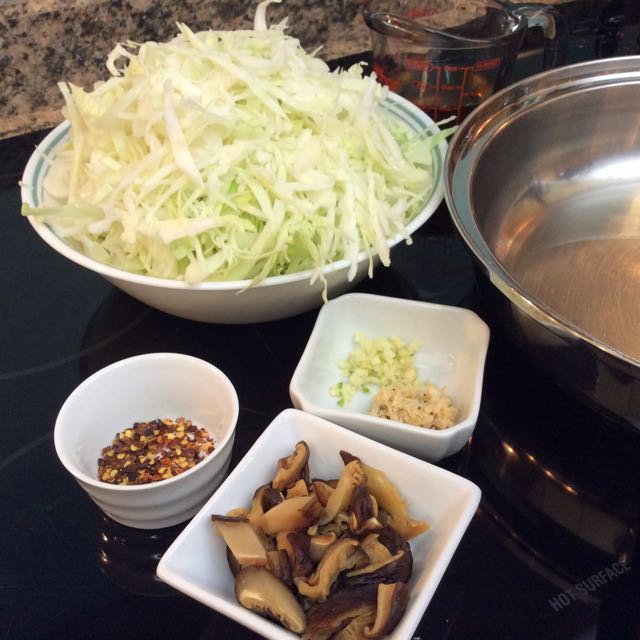
Simple ingredients ready: cabbage, mushroom soaking water, garlic, shrimp, shiitake, red pepper flakes

Simple ingredients ready: cabbage, mushroom soaking water, garlic, shrimp, shiitake, red pepper flakes

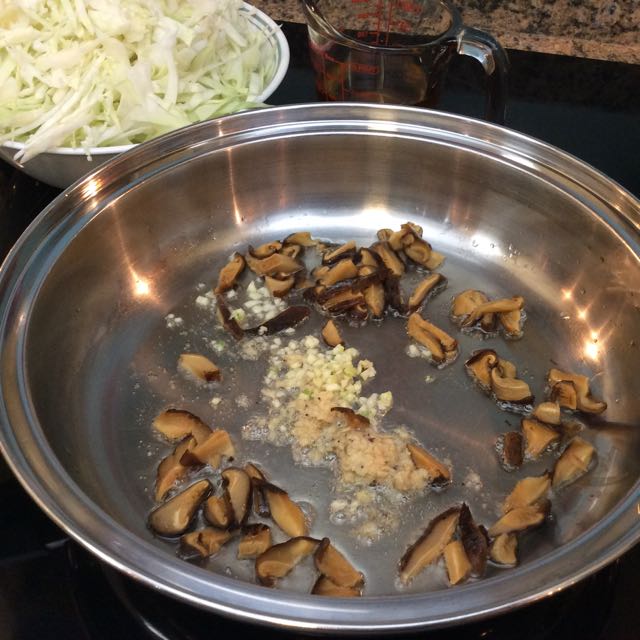
Shiitake, garlic, shrimp cooking in lard

Shiitake, garlic, shrimp cooking in lard

April 8, 2016 by Sally K Norton

Roasted Red Radishes

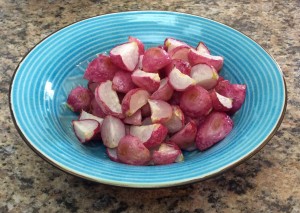
This is popular with both children and adults because roasting tames the spicy bite of a radish. These are simple and sure to please. I like them best when hot, fresh from the oven. Watch out – they go down like popcorn, and may not last long enough to make it to your dinner table. These can be offered as a warm party food, on tooth picks, or with dip.

Roasted Red Radishes

  • Servings: 4
  • Oxalates: 3 mg per serving
  • Time: 25 minutes
  • Difficulty: Easy
  • Print

Ingredients

3 bunches fresh radishes with tops removed (about 1 1/2 lbs.)
2 – 3 tsp. olive oil
mineral salt, to taste

Instructions

  1. Preheat oven to 400 degrees F.
  2. Clean and trim off the root ends. Quarter radishes from top to tail.
  3. In a large bowl, toss radishes with olive oil and salt.
  4. Distribute radishes on a parchment lined baking sheet with sides (jelly-roll pan).
  5. Place in the hot oven. After 5 minutes, lower heat to 375 degrees F. Continue to cook for about 20 minutes, until mostly translucent.
  6. Stir about 3 times during cooking.
  7. Serve immediately, as is.

Frugal option: Use the green tops immediately. Clean, chop and saute greens in hot coconut oil, add salt to taste. Three radish bunches will yield 2 small portions. To serve 4 people, add about 5 oz of chopped arugula greens and cook with the radish tops. Coconut oil gives greens a wonderful flavor.

One serving option is to toss the roasted radishes in with the greens just before serving.

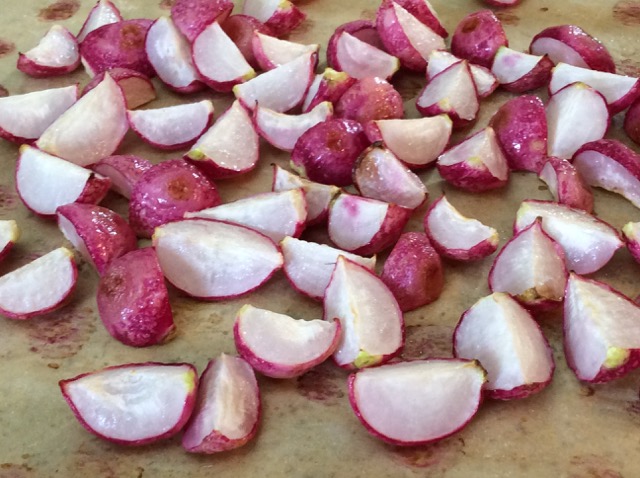
In the photo below, the radishes are almost done. Notice that many have centers that are still white. I like them cooked a bit more – I’d put them back in the oven for an additional 5 minutes.

Roasted Red Radishes Fresh From the Oven

Roasted Red Radishes Fresh From the Oven

January 11, 2016 by Sally K Norton

Fresh Coconut Chutney

This thick condiment is wonderful with anything. Try it with fish, lamb, or beef. Or use as a dip for anything that is crunchy. (Try it with red pepper strips, apple slices, cucumber slices or spears, or Flackers flax seed crackers.)
Here is an appetizer or dessert idea: Try serving with simple fruit “kabobs” made with small pieces of pineapple, red seedless grapes, and apple chucks dipped in lemon water so they don’t brown. String the fruit pieces on toothpicks, offering the chutney on the side. This is a good picnic food. I like it as a snack while preparing dinner.

Fresh Coconut Chutney

  • Servings: 8
  • Time: Prep: 15 minutes; Total: 15 minutes
  • Difficulty: Easy
  • Print
Ingredients

1 lime, juiced (or more to taste)
2 cups washed cilantro leaves, loosely packed (1.5 oz.)
1-2 fresh or frozen red cayenne pepper(s), seeded and chopped
1 1-inch piece fresh ginger root, peeled and minced (or juiced with a garlic press)
1 small-medium Gala or Fuji apple, quartered, cored, and roughly cut up, or crushed pineapple, drained (a generous 1/2 C)
1 scant cup fresh or thawed frozen shredded coconut (available in Indian Market freezer section)
¼ tsp. Mineral salt, optional
1 tsp. honey or 1 T dextrose, optional (only if too tart or using as a dessert)

Instructions

  1. Combine the ingredients in a food processor fitted with a steel knife or a blender. Process until ingredients make a textured paste.
  2. Taste for seasoning and adjust as desired.

December 18, 2015 by Sally K Norton

Lime Lettuce Cucumber Smoothie

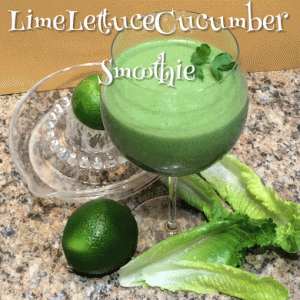
lime smoothie

This is a simple tasty yogurt-based drink. Bright and cheerful flavor of lime accents the gentle flavors of cucumber and romaine. Oxalate per serving is about 15mg if using Gala apple, or 20mg per serving if using pineapple. To make a dairy-free version use coconut milk.

Lime Smoothie

  • Servings: 2
  • Oxalates: Low
  • Time: Prep time: 10 minutes; Total Time: 15 minutes
  • Difficulty: Easy
  • Print
Ingredients

2 Tbsp. flax seed, (sprouted is best, e.g. Go Raw Brand)
2 tsp. liquid coconut oil (medium-chain triglyceride or MCT oil) (optional)
Juice of 1 small lime
10 oz. plain whole fat yogurt (or whole milk Keifer) or 8 oz. coconut milk
1 Gala or Fuji apple, cored and sliced or ½ C fresh pineapple chunks (3 oz.)
1 medium English cucumber, peeled and chopped
1 – 2 C romaine lettuce, chopped
1 – 5 sprigs cilantro (opt.)

Instructions

  1. Put everything in a blender and blend thoroughly.
  2. Let it sit for 5 minutes before enjoying.
  3. Variation: If you own a high-powered blender, you can use frozen coconut and water in place of the dairy products.

  • « Previous Page
  • 1
  • 2
  • 3
  • 4
  • 5
  • 6
  • …
  • 9
  • Next Page »

Search on SallyKNorton.com

Shopping Cart

Number of items in cart: 0

  • Your cart is empty.
  • Total: $0.00
  • Checkout
Click to sign up for email list

Upcoming Events

  • Group Meeting and Presentation

    August 12, 2026 @ 1:00 pm - 3:00 pm
    US Eastern Time
    See more details

  • Group Meeting and Presentation

    August 25, 2026 @ 10:00 am - 12:00 pm
    US Eastern Time
    See more details

  • Carnivore Live Conference, Adelaide, Australia

    September 12, 2026
    US Eastern Time
    See more details

  • Group Meeting and Presentation

    September 18, 2026 @ 9:00 am - 11:00 am
    US Eastern Time
    See more details

Connect

  • Home
  • About
  • Shop
  • Recipes
  • Support
  • Blog
  • Contact
  • Table of Contents
  • Privacy Policy

Visit Sally’s Other Sites

  • YouTube
  • LinkedIn
  • Facebook
  • Instagram

Copyright © 2026 — Sally K. Norton • All rights reserved.

Loading Comments...